

When buying hydraulic cylinders, the worst thing is not an insufficient budget—it is choosing the wrong one. If the bore is too small, thrust will be insufficient; if the rod diameter is too thin, it will bend easily over a long stroke; if the seals do not match the working conditions, oil leaks are likely. In fact, the parameters to consider during selection are not complicated. Just focus on the following items.
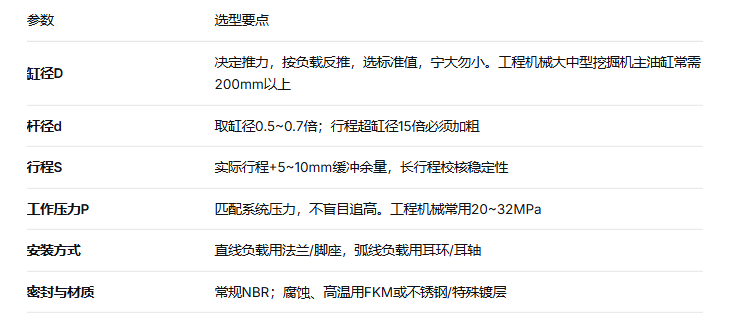
First, look at bore diameter and rod diameter. Bore diameter determines thrust, and thrust equals working pressure multiplied by the effective piston area. At a fixed pressure, the larger the bore, the greater the thrust. To select the bore diameter, work backward from the load and then choose the nearest standard series size, preferring larger over smaller. Common standard bore diameters in construction machinery range from 50 mm to 200 mm and 250 mm. The main cylinders of medium and large excavators often need to be above 200 mm. Piston rod diameter is usually 0.5 to 0.7 times the bore diameter; for heavy-duty conditions, choose the larger value. When the stroke exceeds 15 times the bore diameter, a thicker piston rod must be considered; otherwise, under compression over a long stroke, it is prone to bending.
Next, consider stroke and working pressure. The stroke must cover the actual movement distance of the equipment, with a 5–10 mm cushion allowance to prevent the piston from hitting the cylinder bottom. For long strokes, the piston rod stability must also be checked; the buckling safety factor is recommended to be no less than 3.5. Working pressure must match the hydraulic system; higher is not always better. In construction machinery, medium and large excavators and cranes generally operate at 20–32 MPa, while small equipment and agricultural machinery commonly use 10–16 MPa. If the system pressure is only 10 MPa, choosing a high-pressure cylinder is simply wasteful.
Then consider mounting type, seal material, and cushioning. For linear loads, use flange or foot mounting; for curved loads, use clevis or trunnion mounting. If the logic is reversed, installation will be awkward. For ordinary working conditions, a 45# steel cylinder body, chrome-plated piston rod, and NBR seals can be used; for mining dust, port salt fog, and high-temperature environments, choose stainless steel or special coatings, switch to FKM fluororubber seals, and use a matching high-temperature-resistant solution.
Construction machinery selection requires one extra step: loads are dynamic and impactive, so the dynamic load factor is usually taken as 1.2 to 1.5; do not calculate based only on static load. The same bore diameter and stroke, when used on a dump truck versus an excavator boom, have completely different requirements for piston rod material, cylinder barrel wall thickness, and sealing grade.
Jiangsu Yancheng Youjiaxing has more than 20 years of experience in the field of construction machinery cylinders. Its products cover thin-type cylinders, tie-rod cylinders, engineering cylinders, hydraulic power units, hydraulic presses, servo electric cylinders, etc. It can provide high-temperature-resistant sealing and special coating solutions, and has long-term cooperation with OEMs such as XCMG and Sany Heavy Industry. In choosing a hydraulic cylinder, parameters are the skeleton, and working conditions are the flesh and blood. Only when the two match will the cylinder be able to withstand the load and last long.
 Home
Home Product
 Telephone
 Message